
Writing
起 (qǐ) — how to say "to rise" in Chinese
起
To rise, to get up; to start
verb · measure word
1. to rise, to get up; to startHSK 3.0 · level 3
verb
2. case, instance (of events, incidents)HSK 3.0 · level 5
measure word
Character composition
起
to rise
Radicals / Keys
走
Run
#156 · zǒu · 7 strokes
Collocations
起得早
qǐ de zǎo
to get up early
Examples
我们一起努力,从零开始。
We work hard together, starting from scratch.
太阳从东方升起。
The sun rises from the east.
Mnemonic
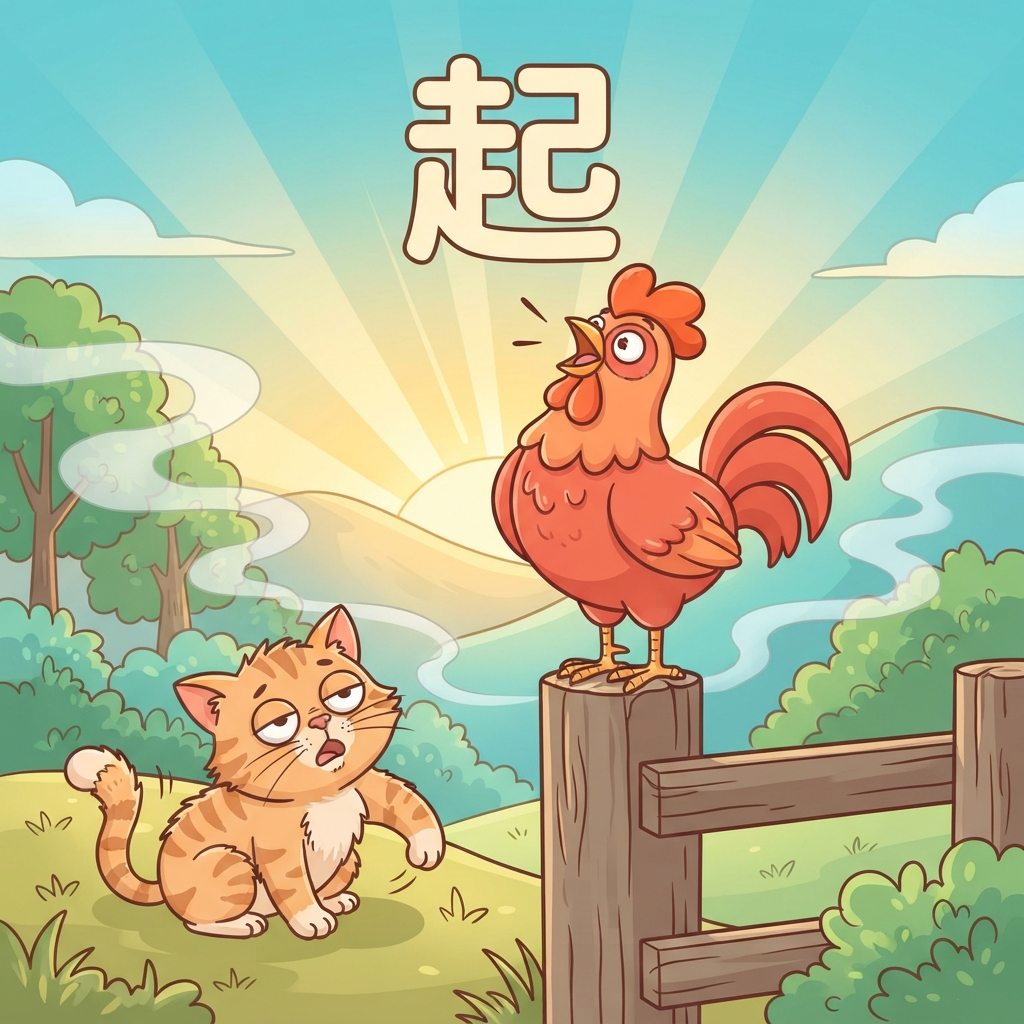
[qǐ-] Early in the morning, Chi the rooster jumped onto the fence and crowed loudly: "Chee-ee!" At that cry everything began to rise: the sun came up, the mist floated upward, and even the sleepy cat got to its feet. So 起 means "to rise, to get up." 🌅🐓
Try remembering 起
Three short exercises on meaning and pronunciation. Free, no sign-up needed.
Frequently asked questions
How to say rise in Mandarin?
"to rise" in Chinese is 起 (qǐ).
起 meaning in English
起 (qǐ) means "To rise, to get up; to start".
How is 起 pronounced?
It is pronounced qǐ (written as qi). You can listen to the pronunciation on this page.
How do you write "to rise" in Chinese characters?
It is written 起 and has 10 strokes. The Writing section above animates the stroke order and lets you trace it.
What HSK 3.0 level is 起?
起 is on the HSK 3.0 level 3 word list. It is not part of the six-level HSK 2.0 lists.
Tomyo
Learn Chinese words with spaced repetition
Add 起 to your vocabulary and remember it with smart reviews, audio and examples.
Grammar with 起
一起 — together
一起 (yìqǐ) + Verb
看起来 — looks, seems
Subj. + 看起来 (kànqǐlái) + Adj.
跟 — compared with
跟 (gēn) + Noun 1 + 比 (bǐ) (起来 (qǐlái)),Noun 2⋯⋯
起来 — starting an action
Verb / Adj. + 起来 (qǐlái)
倒 — but actually, contrary to expectation
倒 (dào)⋯⋯
平时 vs 平常 — usually vs ordinary
平时 (píngshí): ordinary times / 平常 (píngcháng): usually, ordinary