
Writing
了 (le) — how to say "particle" in Chinese
了
Particle (completed action or change of state)
modal particle
How to use it
Does 了 mean past tense?
Not exactly. 了 can frame a bounded event, as in 我买了一本书, where the buying is presented as one complete unit. It can also mark a newly relevant situation, as in 下雨了, meaning it has started raining. 了 is not an automatic past-tense marker, and these jobs can overlap, so position alone is not a strict test.
我买了一本书。
wǒ mǎi le yì běn shū 。
I bought a book.
下雨了。
xià yǔ le 。
It has started raining.
Radicals / Keys
亅
Hook
#6 · jué · 1 stroke
Examples
她已经去学校了,所以我不等她了。
She has already gone to school, so I won't wait for her.
我吃了。
I have eaten.
Mnemonic
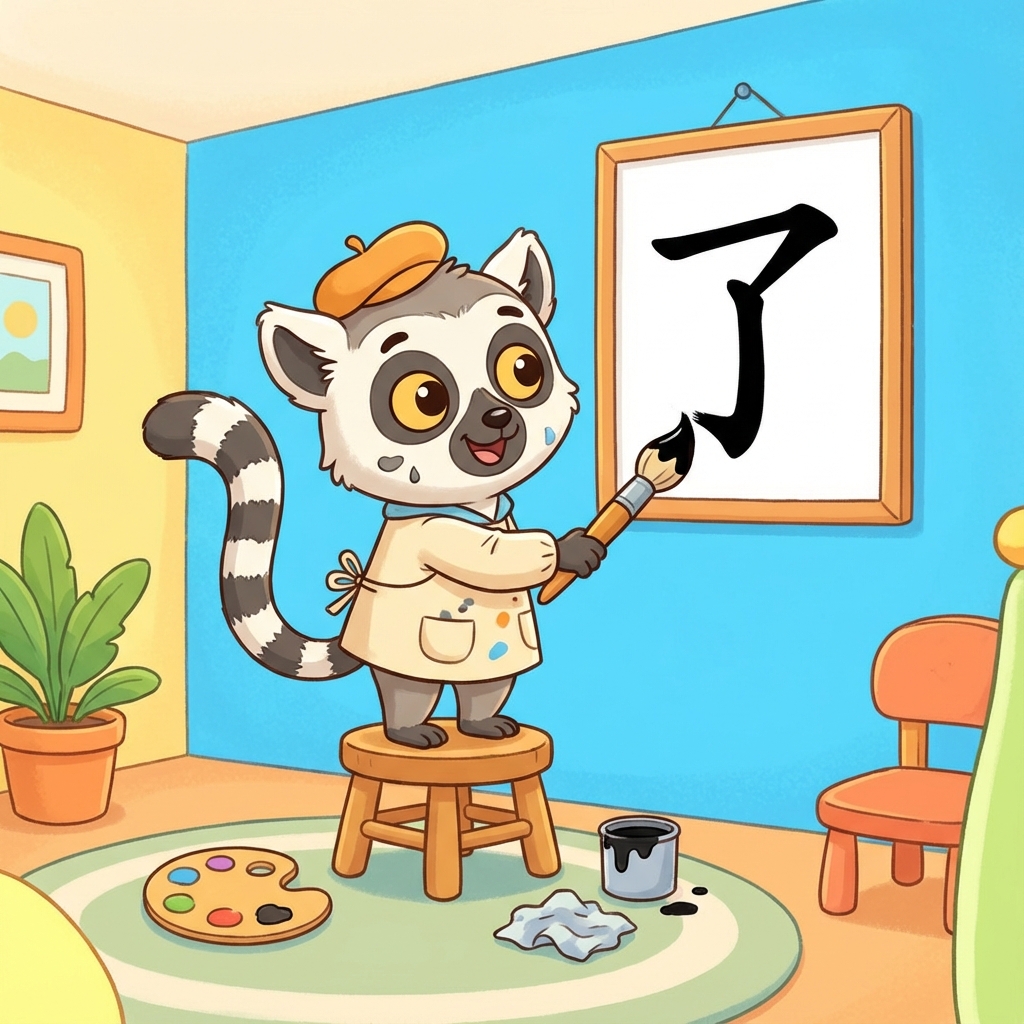
[le-] Lennie the Lizard climbs onto a chair to hang a painting on the wall featuring the Chinese character 了. 🖼️ With a final stroke of the brush, Lennie declares, "Now everything is 了 complete!" He then steps back to admire how the room's state has changed.
Frequently asked questions
How do you say "particle" in Chinese?
"particle" in Chinese is 了 (le).
What does 了 mean in Chinese?
了 (le) means "Particle (completed action or change of state)".
How is 了 pronounced?
It is pronounced le (written as le). You can listen to the pronunciation on this page.
How do you write "particle" in Chinese characters?
It is written 了 and has 2 strokes. The Writing section above animates the stroke order and lets you trace it.
What HSK level is 了?
了 belongs to the HSK 1 vocabulary list.
Tomyo
Learn Chinese words with spaced repetition
Add 了 to your vocabulary and remember it with smart reviews, audio and examples.
Grammar with 了
太 — too, excessively
太 (tài) + Adj. + 了 (le)
了 — change of state
Change of State + 了 (le)
了 — completed action after the verb
Subj. + Verb + 了 (le) + Obj.
了吗 — questions with 了吗
Verb + 了 (le) + 吗 (ma)?
不 — not anymore
不 (bù) + Verb Phrase + 了 (le)
多了 — much more in comparisons
Noun 1 + 比 (bǐ) + Noun 2 + Adj. + 多了 (duō le)