
Writing
次 (cì) — how to say "time" in Chinese
次
Time (classifier for events, actions); next
verbal measure word · adjective
1. time (measure word for occurrences)HSK 3.0 · level 2
verbal measure word
2. second; next; secondary; inferiorHSK 3.0 · level 7-9
adjective
How to use it
Counts actions, not things, and goes after the verb together with the number.
我去过两次北京。
wǒ qù guò liǎng cì běi jīng
I have been to Beijing twice.
Radicals / Keys
欠
Lack
#76 · qiàn · 4 strokes
Collocations
第一次
dì yī cì
the first time
两次
liǎng cì
two times
Examples
我去过北京两次,还想再去一次。
I've been to Beijing twice and want to go again.
我来过两次
I've been here twice.
Mnemonic
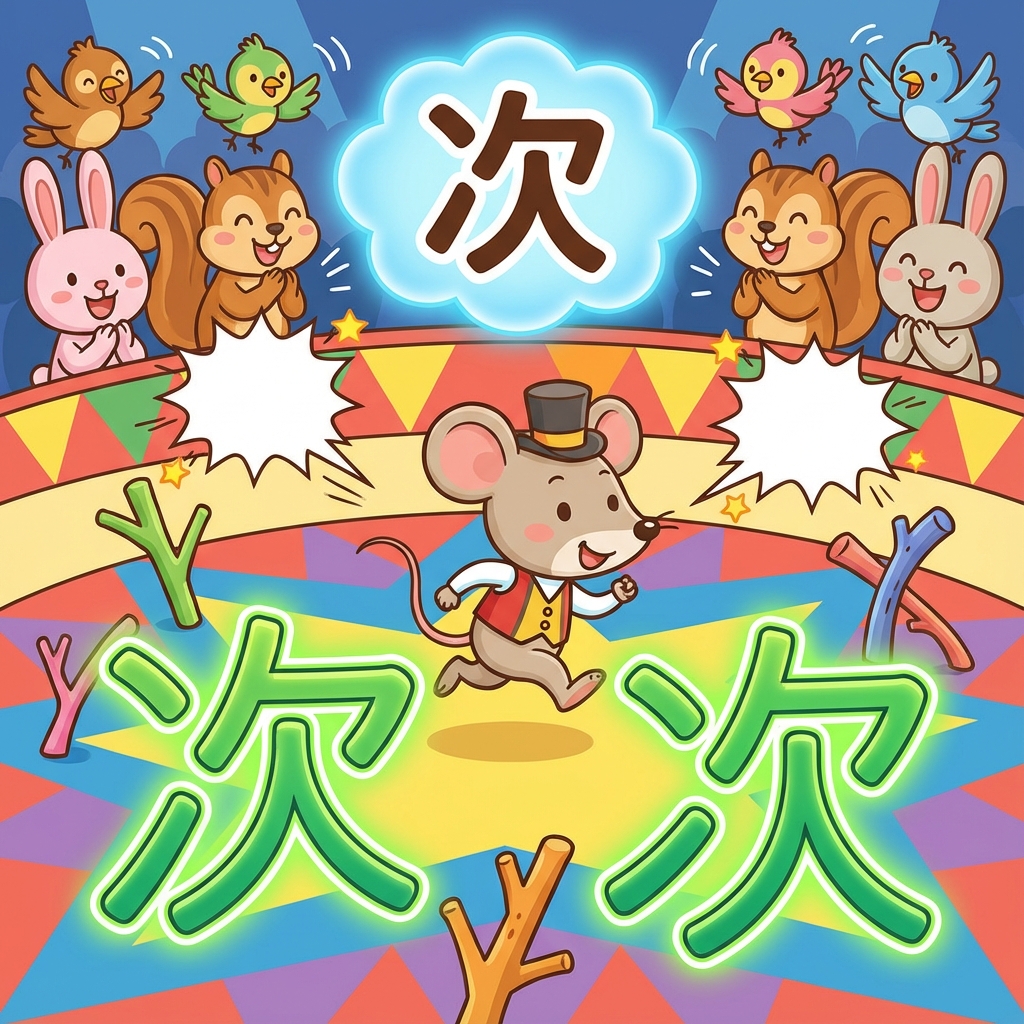
[cì-] City the Cat is an artist painting a mural with the character 次. As he adds the final 次 "brush stroke" with a flourish 🎨, he tells his audience, "Each 次 time, my art gets better!" The crowd watches eagerly for his next masterpiece.
Frequently asked questions
How do you say "time" in Chinese?
"time" in Chinese is 次 (cì).
次 meaning in English
次 (cì) means "Time (classifier for events, actions); next".
How is 次 pronounced?
It is pronounced cì (written as ci). You can listen to the pronunciation on this page.
How do you write "time" in Chinese characters?
It is written 次 and has 6 strokes. The Writing section above animates the stroke order and lets you trace it.
What HSK level is 次?
次 belongs to the HSK 2 vocabulary list.
Tomyo
Learn Chinese words with spaced repetition
Add 次 to your vocabulary and remember it with smart reviews, audio and examples.
Grammar with 次
每次 — every time
每次 (měi cì) + Event 1 + 都 (dōu) + Event 2
次 — verb measure words
Verb + Number + Measure Word
第 — ordinal numbers
第 (dì) + Number (+ Measure Word)
可 — evaluative judgment
Subj. + 可谓 (kěwèi) + Adj. / Noun
不免 vs 未免 — “inevitably” vs “a bit too”
Subject + 不免 (bùmiǎn) + Predicate; Subject + 未免 (wèimiǎn) + (太 (tài)) + Predicate
仅次于 — second only to
Subj. + 仅次于 (jǐn cì yú) + X