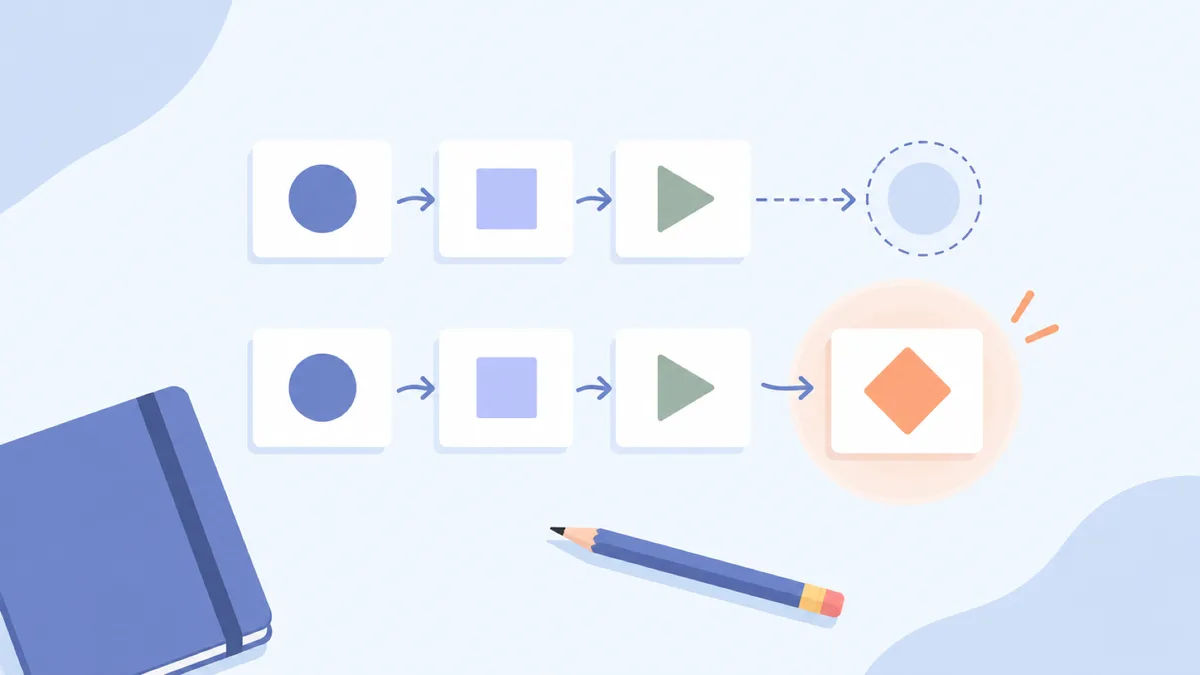
“I keep studying, but I am no longer improving.” That is how learners usually describe a plateau in learning Chinese. The sentence is understandable, but it is almost useless for solving the problem. It can point to very different situations: a skill is growing even though the result is not yet visible; familiar material is being reviewed but not retrieved from memory; the difficulty has moved beyond a workable range; or the workload is there but meaningful feedback is not. From the learner’s perspective, all of these feel the same: time goes in, yet the earlier sense of acceleration is gone.
A plateau is not a diagnosis. It is a sign that your usual metrics no longer explain what is happening to the skill.
Why study activity does not show progress
A streak, study time, and the number of reviews are good measures of consistency. They matter because learning cannot happen without contact with the language. But do they show transfer? You can recognize a word on a flashcard without hearing it in connected speech. You can understand a grammar rule yet fail to choose the construction in your own sentence. You can read an adapted text with support and become lost in a text at the same level once that support is removed.
What you can see: plenty of reviews and few mistakes in familiar tasks.
What you need to test: whether the result holds when the prompt disappears, the context changes, and you must retrieve the answer yourself.
This is why the question “Is this a normal plateau or a bad method?” cannot be settled by mood. You need a short test that separates study activity from the target skill itself.
Four causes of a plateau in Chinese
The first is hidden accumulation. Fatigue, topic, speech rate, and even a lucky concentration of familiar vocabulary can affect a single attempt. One bad day proves nothing. But if comparable tasks gradually yield better comprehension, faster answers, or less dependence on prompts, the skill is developing regardless of how progress feels.
Another case is recognition without retrieval. The answer looks obvious after you see it but does not come to mind beforehand. This is particularly clear with vocabulary and grammar patterns. “I know this” may only mean “I have seen this many times.” This is how a passive vocabulary grows. Speaking, writing, and listening require you to retrieve the form at the right moment, not merely confirm it after the fact.
Sometimes practice has fallen below a productive level of difficulty. The learner performs confidently, but the conditions never change: the same list, the same pace, the same format. Performance is stable inside the exercise and unstable outside it. Easy practice still has a role in building accuracy and automaticity. The problem begins when the study week contains no task that asks the skill to survive a new context.
Finally, there is overload. Material can be so difficult that you can no longer isolate the reason for an error. In a long audio clip, missing vocabulary, blurred phrase boundaries, and a lost storyline may all occur at once. Replaying the clip will make that particular recording more familiar, but it may not reveal a clear target for practice. A similar process occurs in reading when dictionary use starts to obstruct comprehension.
Productive difficulty is not a task you can barely endure. It is a task that leaves you able to say what needs to be fixed.
These states call for different responses. With hidden accumulation, keep the course and measure less often. With weak retrieval, add recall without support. If practice is too easy, change the context. If the material is overwhelming, narrow it until the error becomes observable again.
Diagnosing a plateau starts with one skill
“Improve my Chinese” is not a testable outcome. A two-week experiment needs one narrow goal. Understand the main point of a one-minute audio clip. Read an adapted text without constantly consulting a dictionary. Use ten target words in sentences. Tell a short story without a prepared script. One option is enough.
Now establish a baseline with a task that is short, repeatable, and not reducible to a familiar exercise. For listening, use a new clip at a consistent level and in the same genre. For reading, choose texts with comparable length and density of unfamiliar words. For active vocabulary, keep the type of communication task the same while changing the specific scenario.
Do not use the exact same material for the final check. That would measure memory for one text. You need a parallel task with the same level, format, and length but new content.
A good progress check matches the requirements of the learning task without sharing its answers.
A two-week protocol for checking progress
On the first day, complete the baseline task without warming up and record the result. Then work in short cycles. First, bring the relevant elements back into focus: words, constructions, or sound distinctions. Next, retrieve them without a ready-made answer. Only then move them into a new context: another text, voice, topic, or sentence of your own.
For vocabulary, this might mean reviewing a limited set of cards, producing the translation or Chinese form before revealing the answer, and then meeting or using those words in a short text. For reading, isolate one difficult mechanism, read a new passage without stopping constantly, and check the unclear points only after the first pass. For listening, work with short segments before listening once to a new clip in full and reconstructing its meaning.
Study habit: add new material every day to preserve a sense of movement.
Working protocol: hold one goal steady, alternate support, retrieval, and transfer, then compare performance on a new task of the same type.
Tomyo already has formats that can support this experiment, although the app does not diagnose the plateau for you. Flashcards and quick review support vocabulary retrieval. Daily texts and adapted news provide new contexts. In Echo, learners can listen to lines and repeat them while hiding or revealing Chinese text, pinyin, and translation. Progress and streaks show consistency; the learner still identifies the cause of the plateau through the chosen benchmark task.
How to interpret the result
Did the final task improve at the same level of difficulty even though you felt no breakthrough? That is likely hidden accumulation. There is no need to change the method immediately. Continuing the cycle and checking less often is more reasonable. Even a small gain in speed, accuracy, or independence from prompts is more reliable than a feeling of novelty.
If familiar exercises go well but a new task remains unchanged, the likely issue is transfer. Reduce repeated viewing and increase independent reconstruction: retell the content, answer before seeing a prompt, read a new passage, or recognize familiar words spoken by another voice.
If many errors cluster around one element, that is useful information: the problem has become observable. Narrow practice to that element for a while, then place it back into a complete task. If the errors are different every time and analysis does not reveal what to train, the difficulty is probably too high.
If none of the metrics changes, examine the experiment itself. Perhaps the two weeks were split among different skills, the benchmark tasks were not comparable, practice still consisted mainly of recognition, or the chosen metric was too coarse. Only after checking the design does it make sense to increase volume or replace the method entirely.
Change the method not when the sense of speed disappears, but when a comparable test shows no transfer and the same failure mechanism remains.
Where the protocol stops working
A two-week check does not treat burnout. If study produces persistent aversion, sleep is disrupted, and attention falls apart even on simple material, another layer of monitoring will only add pressure. The task then is to reduce the load, restore a workable routine, and return to minimal contact with the language without demanding immediate growth.
The protocol cannot replace a foundation either. You cannot diagnose a subtle listening problem if half the key words in every sentence are unknown. Start with more accessible material and a limited set of supports. It also cannot replace external feedback where the learner cannot hear the error—for example, a persistent issue in their own pronunciation. A recording can help, but it is not equivalent to feedback from a teacher or a competent partner.
A plateau becomes manageable when it stops being a general judgment about your ability. “I have no talent for this” gives way to three concrete questions: What should change? Which task would show that change? What mechanism is my current practice training? The answer may be to continue, transfer the skill to a new context, lower the difficulty, or rest. In every case, the decision should follow observation rather than an attempt to recover the fast progress of the beginner stage at any cost.